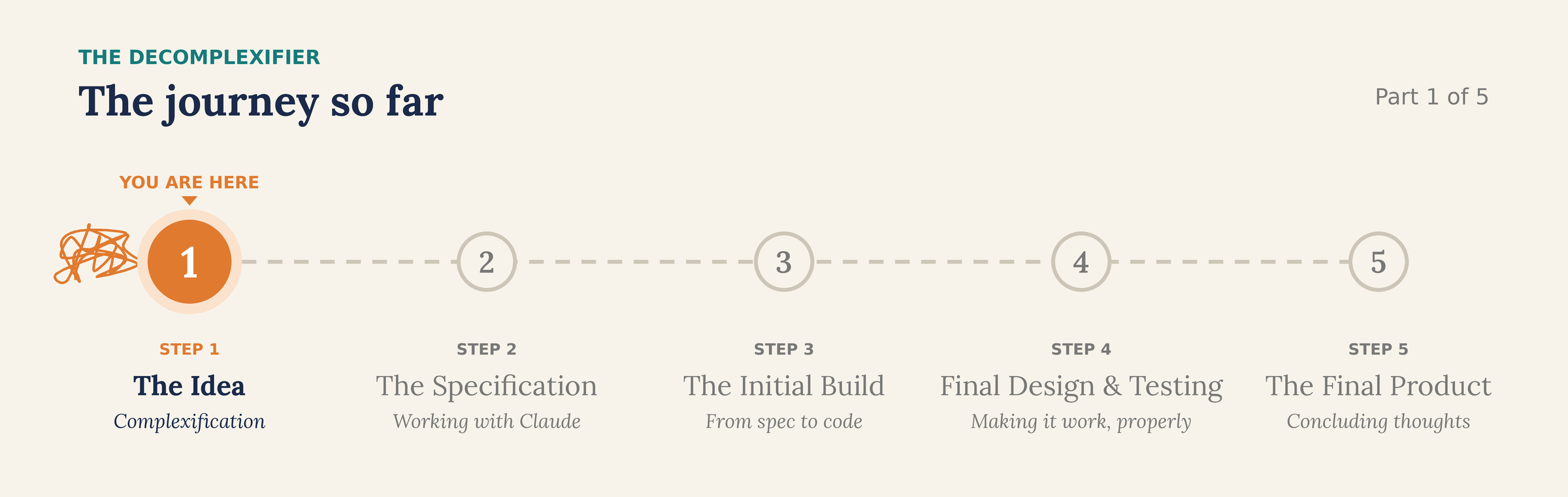
In part 1 of the series, we are going to start with our initial idea, and offer some thoughts on how AI tools might help us turn this into reality
The Decomplexifier, Part 1: Complexification and Ideas
The Decomplexifier series
- Complexification and Ideas ← you are here
- Specifying and Refining
- The Beta Build
- Refinement and Testing
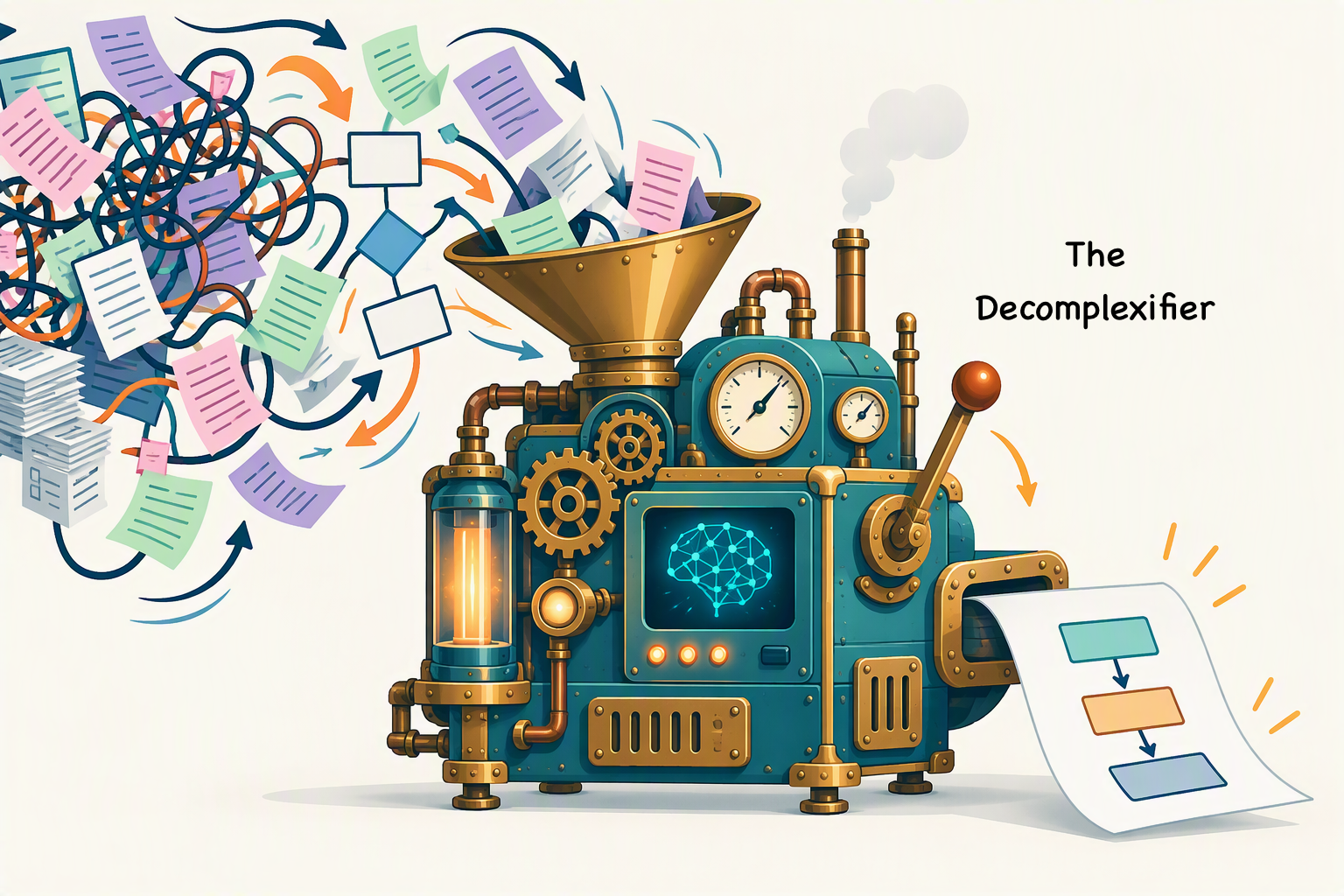
An assistant for your best ideas
I often used to remark to people how useful it would be to have a person, an assistant, that you could talk to whenever you got a really amazing idea, and who would help to make that idea a reality. What a powerful concept that would be.
Well, I guess in some ways we now have that, in the form of AI. I was reflecting on that this week, but it also brought me back to a fundamental question: what should we use AI for?
What is complexification?
Anyone who has followed any of my writing in the past, or knows me at all, will know that one of my ongoing missions centres around a word: complexification.
The first thing people say when I use this word is that it isn’t a real word, but it actually is. When I started using it, I wasn’t really aware that it was, but after several people challenged me and asked me to produce a dictionary definition, I looked it up. Here is the definition for you:
complexification (noun): The act or process of making something more complex.1
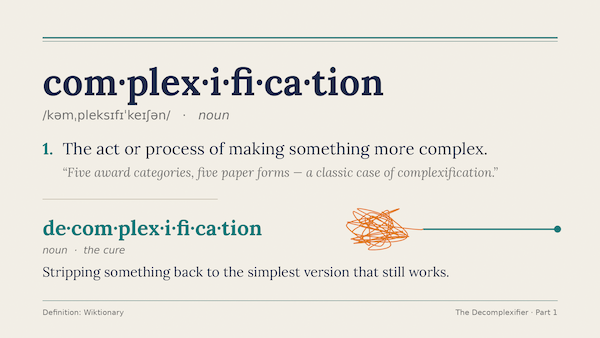
It’s not even a new word. Back in the 1950s, the French philosopher Pierre Teilhard de Chardin was writing about what he called “the law of complexification” in The Phenomenon of Man.2 So I’m in good company.
Very little annoys me, but complexification does. Even though I didn’t invent the word, it’s one I’ve come to think about a lot in recent years.
Fighting back the tide
Life has a habit of running away and tending towards more complexity. And technology trends, including AI, don’t really help with that. We should be inventing things to make our lives simpler, but if we’re not very careful, they have the opposite effect.
Here’s a quote from Steven Pinker that I think is brilliant:
“The ultimate purpose of life, mind, and human striving: to deploy energy and information to fight back the tide of entropy and carve out refuges of beneficial order.” — Steven Pinker3
And I agree. So often we see technology projects, AI or otherwise, actually making things more complicated. Once you start looking for complexification, you’ll find it everywhere. The first step in fighting back is to identify that tide of complexification in the first place.
To understand what complexification is, both at home and at work, and to show how it can be a real demotivator, let’s take a few examples.
Complexification at home
As I write this, I can look around and see stacks of paper, a pair of binoculars, wires, and lots of other clutter. Perhaps that’s a sign that physical complexification has occurred. Nobody sets out to create clutter; it just builds up, one “I’ll deal with that later” at a time.
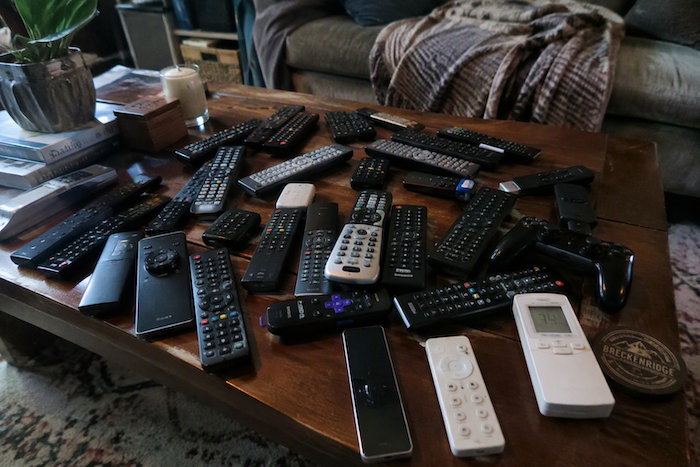
It’s not just physical, either. Take watching TV. It used to be one remote and a handful of channels. Now it’s a TV remote, a soundbar remote and a streaming box, plus four or five different apps, each with its own subscription, login and idea of where the thing you were watching has gone. All of that technology was supposed to make life easier, and yet just sitting down to watch something has become a process.
Complexification at work
Here are some examples of complexification at work:
- Staff awards. I recently had to deal with a set of internal staff awards. There were five categories, and each one had a separate, multi-page paper form, which had to be wet signed, scanned, and emailed to the HR department.
- IT accounts. In a previous existence, when you needed a new IT account, you had to fill out a form and have it signed by three different people. The form was pink, green, or purple, depending on the type of account you needed — if, in fact, you could work out which one you needed.
- Meeting rooms. How about booking a meeting room in less than two minutes without breaking a sweat? It just can’t be done.
How does complexification happen?
One of the key ways it happens is when you invite someone to improve or create a new process. In a business, that might be a member of contract staff, or someone you’re paying. Without guidance, they’re unlikely to come up with the simplest, most minimal process.
In fact, when they start writing the process, they’ll probably want to include as much detail as possible, so that you pay them their money and think they’ve done a good job. So they might include a diagram, some extra steps, or capture an additional piece of data that just seems like a good idea at the time. Maybe it gives you better reporting for the future, or maybe it links up to other systems or processes, or gives better management information.
But then that process becomes the start of another process, or a link in an existing chain of steps. Quickly, over time, those steps together become more complicated than they need to be, and the process ends up in another chain of processes. Eventually, you end up with a very complicated process that doesn’t need to be so complicated. If you look around, you’ll see loads of examples of this.
A lesson from Elon Musk’s “algorithm”
One of my favourite engineering practices is Elon Musk’s five-step “algorithm”, which he drills into his teams at SpaceX and Tesla. Walter Isaacson describes it in his biography of Musk,4 and the five steps are:
- Question every requirement.
- Delete any part or process you can.
- Simplify and optimise.
- Accelerate cycle time.
- Automate.
The step I love is number two. Musk’s rule of thumb is that if you don’t end up adding back at least 10% of what you deleted, you didn’t delete enough. In other words, the challenge is to remove so much that the process actually breaks and you have to start putting things back in.
What’s interesting is that simplifying only comes third. Musk’s point is that there’s no use simplifying and optimising something that shouldn’t exist in the first place. And automation comes last of all. He has admitted that one of his big mistakes in the Tesla factories was trying to automate every step first.
Now, I’m not advocating going quite that far. But clearly, in engineering, in business, and even in our own lives, there’s lots of stuff that’s more complicated than it needs to be, which leads to inefficiency.
What has this got to do with AI?
AI is often used to automate existing processes. If we automate processes that are already complex, then at best the efficiency saving won’t be as great as it could be, and at worst we’ll make a bad and unnecessary process even worse. Musk learned that lesson the hard way, and it’s one we should take on board before we point AI at everything.
Introducing the Decomplexifier
So this week is the first week of an experiment. It’s an experiment with AI, and with that concept of a person who can take your best ideas and run with them. Together, we’re going to build the Decomplexifier.
The outline concept is that it will be a web-based tool where you can feed in an existing process, or set of processes, through a number of different mechanisms. The machine will decomplexify it and feed you back the minimal viable process.
I see this as both a powerful tool and an extremely cathartic way of helping to reduce complexification in the world, which I think we should all be doing.
Over the next few weeks, I’m going to work with an AI to create a working system, and I’m hoping you’ll come along with me. Next week, we’ll start work on the specification. But for now, I hope I’ve helped you understand what complexification is, and why it’s so important to me.
References
Footnotes
-
“complexification”, Wiktionary. https://en.wiktionary.org/wiki/complexification. See also “complexify”, Merriam-Webster: https://www.merriam-webster.com/dictionary/complexify. ↩
-
Pierre Teilhard de Chardin, The Phenomenon of Man (first published 1955). Quoted in the Wiktionary entry above. ↩
-
Steven Pinker, “The Second Law of Thermodynamics”, Edge Annual Question 2017: “What scientific term or concept ought to be more widely known?” https://www.edge.org/node/27023. Pinker develops the same idea in Enlightenment Now (2018). ↩
-
Walter Isaacson, Elon Musk (Simon & Schuster, 2023). For a summary of the five steps, see Corporate Rebels, “Musk’s 5 Step Algorithm to Cut Internal Bureaucracy at Tesla and SpaceX”: https://www.corporate-rebels.com/blog/musks-algorithm-to-cut-bureaucracy. ↩